Ten of Swords and Seven of Cups
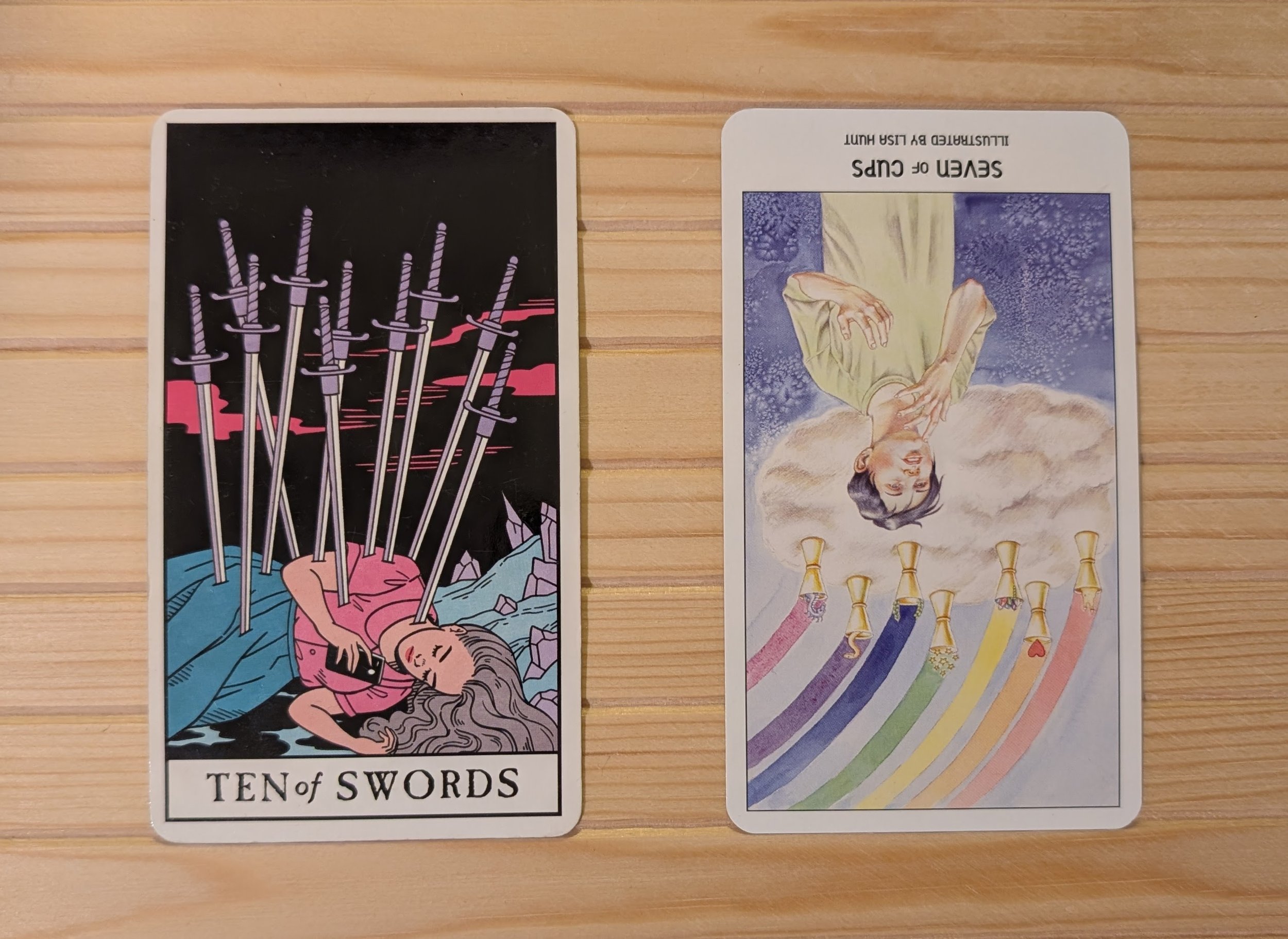
Woof. The Ten of Swords and the Seven of Cups reversed.
In Tarot, patterns can tell you information just as much as a card. If you look at the last three readings, I have been pulling a lot of swords. As Cat Rocketship says, “all swords have some threatening energy.” Even the resting Four has (in the RWS illustration) the character resting in a tomb. I have 16 swords in a 90-card deck; the odds of pulling 3 or more of them in three two-card spreads are close to 3%. I guess I am thinking too much as opposed to doing, but we’ll see what tomorrow brings.
This Ten of Swords is from the Modern Witch Tarot by Lisa Sterle, and is the entire reason I bought that deck. No other version of the Ten of Swords grabs me like this one. Your thoughts have betrayed you, and the only escape you can conjure to dodge out of the obsessive—likely absolute—thoughts is gazing at your phone. A poor coping strategy at best. You don’t have to think about “whether or not you can be loved” if you are on Reddit. I feel this as I engage in this avoidance all the time. Social media means very little to my life. Yet, I feel compelled to check it. It never helps.
Little efforts can make big changes, but little amounts of waste and rumination over time can become tragedies. Thus, the Ten of Swords rears its head.
The Seven of Cups, illustrated by Lisa Hunt from the Pride Tarot, is reversed. I generally don’t read reverses, but it felt right this time. A big part of tarot is trusting your choices, so here we go. The Seven is about the choices arrayed in front of the subject of the card. This version of the card is, in some sense, a reversal of the traditional Seven: the main character is looking away from all the choices. His back to the options, the central figure just can’t seemingly make the choice. There is safety in that. If you don’t choose, you never have to take a risk. Of course, never risking anything is a risk in itself.
The two combined show a world where you avoid instead of explore your thoughts, and then fail to choose any other option.
These cards don’t give you a magical way out, and I’m sorry: you’re going to have to do this on your own. Knowing and acknowledging the problem is the first step. When you are ready take time to look at your behaviors, especially those you find detrimental. In my example, why do I spend time on social media when I could be writing, working out, or otherwise doing something I love? That fierce inventory is what the Ten of Swords demands.
Then look at your inventory and choose. You can’t change everything all at once—humans just aren’t built like that. If you can’t choose, list everything out and roll a dice. Even if you don’t follow what the dice says, it generates focus. Being forced to consider an option might tell you what you actually want to do.
Then you just have to do it. That’s the hard part.
Notes:
Jessica Dore has a great write-up of the Ten of Swords in Tarot for Change that this post cribs.