
Five of Swords
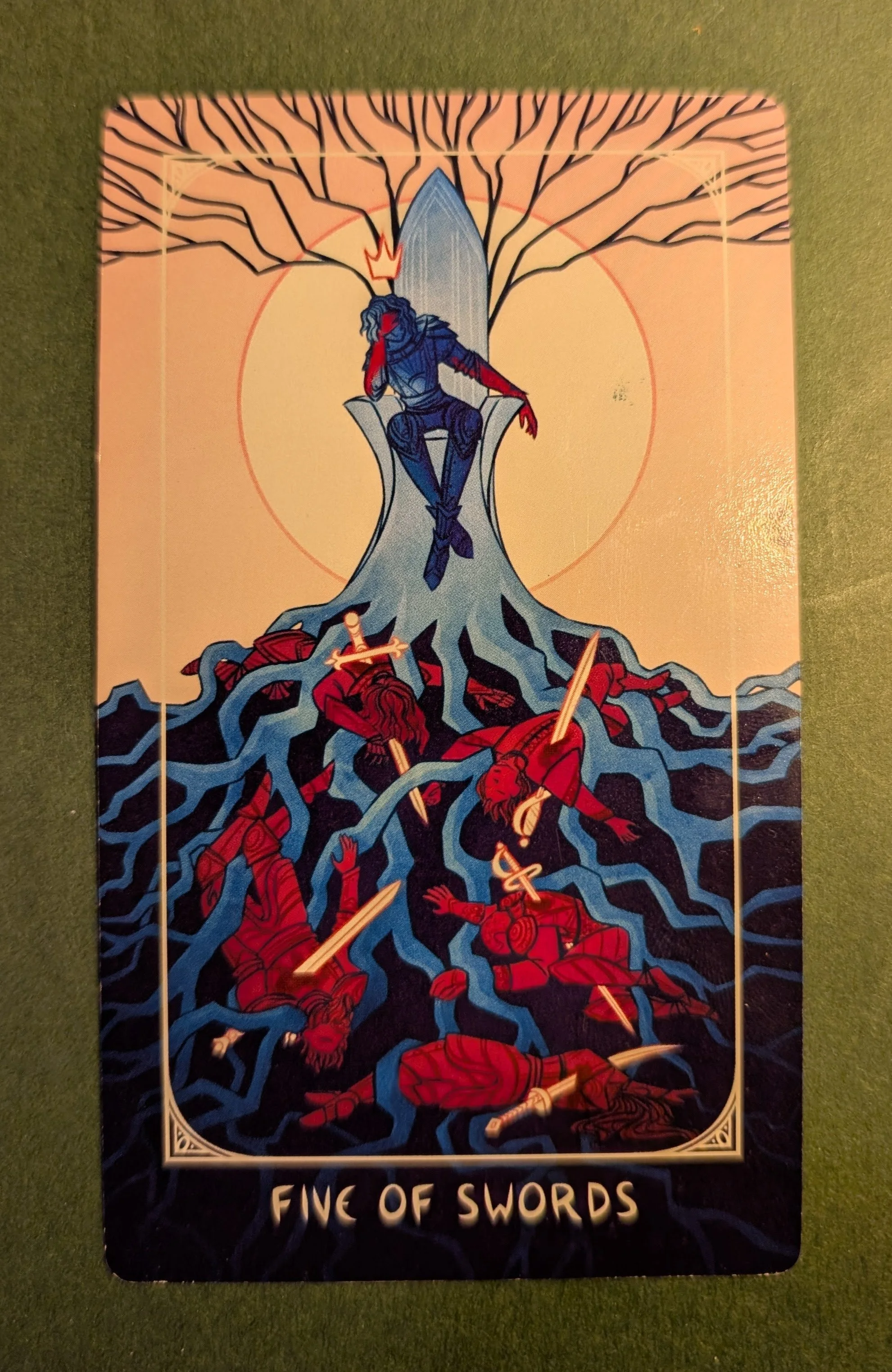
The Five of Swords by Sam Dow for the Alleyman Tarot
Imagine being the kind of person that people name as the Ur example. You get a word named after you. We know that the ancient Athenian Draco was a jerk, because we have the word “Draconian,” which means “excessively cruel”. The historical Draco was slightly more nuanced (but still a mean classist and brutal leader), but that is what you get when your entire life is compressed into a single word. Since this has filtered down through our culture, anyone named Draco makes us feel slightly uncomfortable—even if we don’t know why—and if a book has a classist villain named Draco, you should be on high alert that the writer is a hack.
And this brings us to the Five of Swords. A Pyrrhic victory.
Pyrrhus of Epirus had a bad couple of days. We know this because his name notes a victory that is actually a defeat—winning so hard you lose. So the story goes: Pyrrhus, a Greek marching around Italy, took on the Romans at the Battle of Asculum. Traditionally, Pyrrhus is considered to have “won” the battle, but lost a large portion of his commanders and the troops he brought to Italy; Pyrrhus couldn’t replace his quality soldiers, while Rome easily summoned up more legions. Thus, a tactical victory is a strategic loss. Pyrrhus booked it out of the Italian peninsula, landed in Sicily, and fought some Carthaginians. He wouldn’t be the last invader of Italy to be worn down like this.
Then comes the moment we all know: a soldier comes to Pyrrhus after defeating the Romans and asks why Pyrrhus isn’t celebrating their victory. Traditionally, the general responded with "If we are victorious in one more battle with the Romans, we shall be utterly ruined".
The interesting part: if you zoom out, Pyrrhus is an exceptional commander. He starts as the King of Epirus, then is thrown out. He comes back with an army to claim his Kingship a second time. He also became the King of Macedon by conquest, invaded Italy, and ruled Sicily by kicking out the Carthaginians. Even before he “won” against the Romans at Asculum, he had thrashed a different Roman army at Heraclea. He often retreats when he needs to, and—in an era with low expectations for leaders—occasionally avoids a civil war. His losses at Asculum, while significant, seem to be a blip in his career. His contemporaries considered him a great, if restless leader. Not always the best of kings, but a talented and exceptional military commander.
Each card in a tarot deck is like that, a moment in a storied life, but you have to take it in the context of who you are and where you are going. Pyrrhus had his moment, his winning loss, but then took on another opportunity and conquered Sicily. The battle of Asculum bothered him, but he didn’t let that define him. We did that for him long after he was dead.
When you pull the Five of Swords, you can let it define you or not.
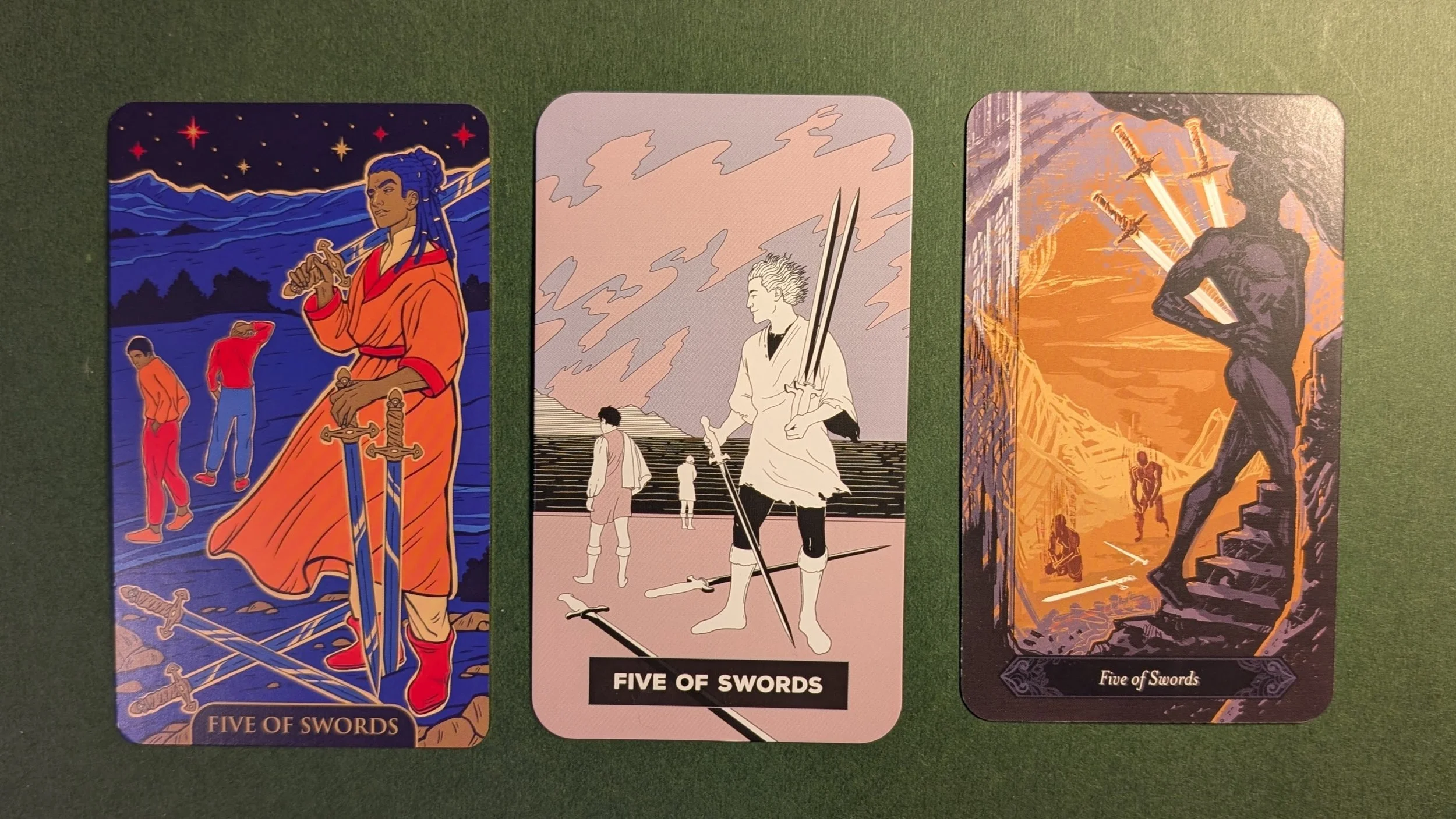
Five of Swords by Wyspell, Xaviera Lopez, and E. Lubanko
Your first and easiest consideration is: Are you fighting for a Pyrrhic victory? I know some finance guys, and they like to say “is the juice worth the squeeze” when talking about analysis. This is kind of the same thing. Sometimes you can get out of the fight and redirect your efforts to a more sustainable path. Sometimes the Romans are there, and you have to dive in, or else the consequences are worse. Rather a Pyrrhic Victory than a rout. Probably. The important point here is that you see that happening.
Military commanders throughout history have a range of competency, from people who truly understood what they were doing to people who just got everyone killed. Pyrrhus’s famous line after the battle shows he understood exactly what happened. That awareness shouldn’t be taken for granted, especially with ancient generals who were often generals because they had the cash. Remember, this general soberly assessed the damage to his army shortly after he won, when he probably should have been drunk. Thousands of dead soldiers wish their commanders had Phyrrus’s vision.
For someone who doesn’t see the Pyrrhic victory, it will feel like a series of mediocre outcomes. No valiant success, no giant failure to learn from. A mediocre outcome is a tease. “Maybe you can grind your way through it,” it whispers. You build enough strength or reserves to watch them lost in the next excursion. Pyrrhus would know that something’s gotta give.
The second consideration: are you letting a Pyrrhic victory (or, say, a mistake) define you? We make mistakes, and sometimes even our best-laid plans lead to strategic defeat—even if we won some tactical victories along the way. Are you dwelling or ruminating on such an experience? Why? The real question is: how will you live, learn, and move on? Sometimes this requires deep soul-searching, and sometimes you just need to get back on that horse. Just remember, Pyrrhus got right back to generaling and conquering after his “victory”.
Finally, if you sacrificed others for your “victory,” it's time to think about atonement. How do you rebuild those bridges? How does a king say sorry to the pawns he sacrificed? Was it necessary? How do you work to heal the pain you caused others, and accept responsibility for your actions? Learning from this is half the battle, but the other half is making amends. This is hard, and Pyrrhus doesn’t offer real guidance. He’s too flighty. It’s a long process, and you have to do the work, so if you need to do it, you'd best get to it.