Man, that’s a lot of swords: Tarot and Probability.
I finally read Tarot Interactions by Deborah Lipp, and she notes that the distribution of cards in a spread can also give insight into the reading. She notes that when the distribution is uneven, that counts as “another card” in the spread.
She really doesn’t go into the math, but provides a chart or two showing “normal” distributions of cards. She states that when the cards in a spread are outside those distributions, that means something. I think that’s cool and insightful. It also reminds me of this meme.

Half a meme. Original from https://jakelikesonions.com/
I am a “show your work” kind of guy. First, people get it wrong, especially with probability, and it’s nice to see where they (or I) go wrong. Second, when we look at the numbers, we get to decide what is worth interpreting and what should be left unsaid. This allows us to tailor how we read our cards.
To figure out the odds of drawing a sword or a Major Arcana, my process is to
Figure out the total combination of cards you can get with the number of pulls you decide on
Figure out the number of “successes” for the set conditions. (e.g., pulling two or more Swords on a three-card spread)
One caveat for this math, order doesn’t matter; pulling the Ace of Swords, Two of Pentacles, and Strength, or Strength, Ace of Swords, and Two of Pentacles counts as the same combination, even though they would have distinct readings. We only care about the distribution of cards, not the order.
Let’s do a standard 3-card pull.
The number of unique card combinations.
When you pull 3 cards from a tarot deck, the odds of each pull change because the deck isn’t replenished between pulls. When you pull the first card, you have 78 cards to choose from, then the second card is 77, and finally, the third card is 76.
If you multiply all of these together, you get 456,456 unique combinations, but this considers the order of the cards. Since order doesn’t matter to us, you have to divide that number by a factorial of the number of cards pulled: 3*2*1 or 6. Dividing 456,456 by 6 gets you 76,076.
How many of a certain type?
What are the odds of pulling at least 2 swords in a three-card pull? We already have the number of unique combinations in a standard tarot deck. We can use the same method above to calculate successes.
First, we have to determine the odds of pulling exactly two swords. There are 14 cards in a suit, so the odds of pulling two cards in a suit are (14*13)/(2*1) = 91, and then we have to toss in the last card not from that suit, which is (78-14) 64/1. Thus, the total number of combinations is 91*64 = 5,824. If we divided this by the unique combinations above, it would tell us the odds of pulling exactly two swords in a 3-card pull. Which is 7.66%
But we want to know the odds of getting two or more cards, so we have to do some more math: specifically, what are the odds of getting 3 swords? The math for that is (14*13*12)/(3*2*1) or 2,814/6 or 364.
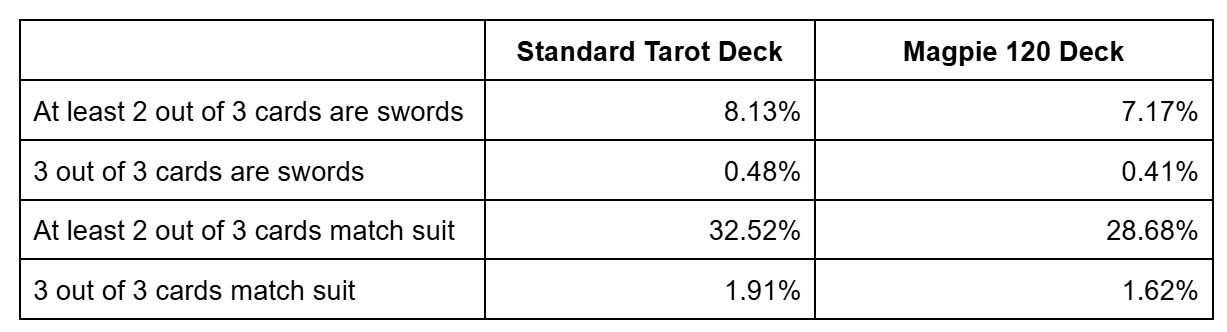
So we add the two amounts from above (5,824+364) to get 6,188. We divide that by the total number of combinations (76,076), or about 8.13%. It’s your choice to consider that “significant”. I do. It's about the same odds as rolling an 11 or 12 on two six-sided dice.
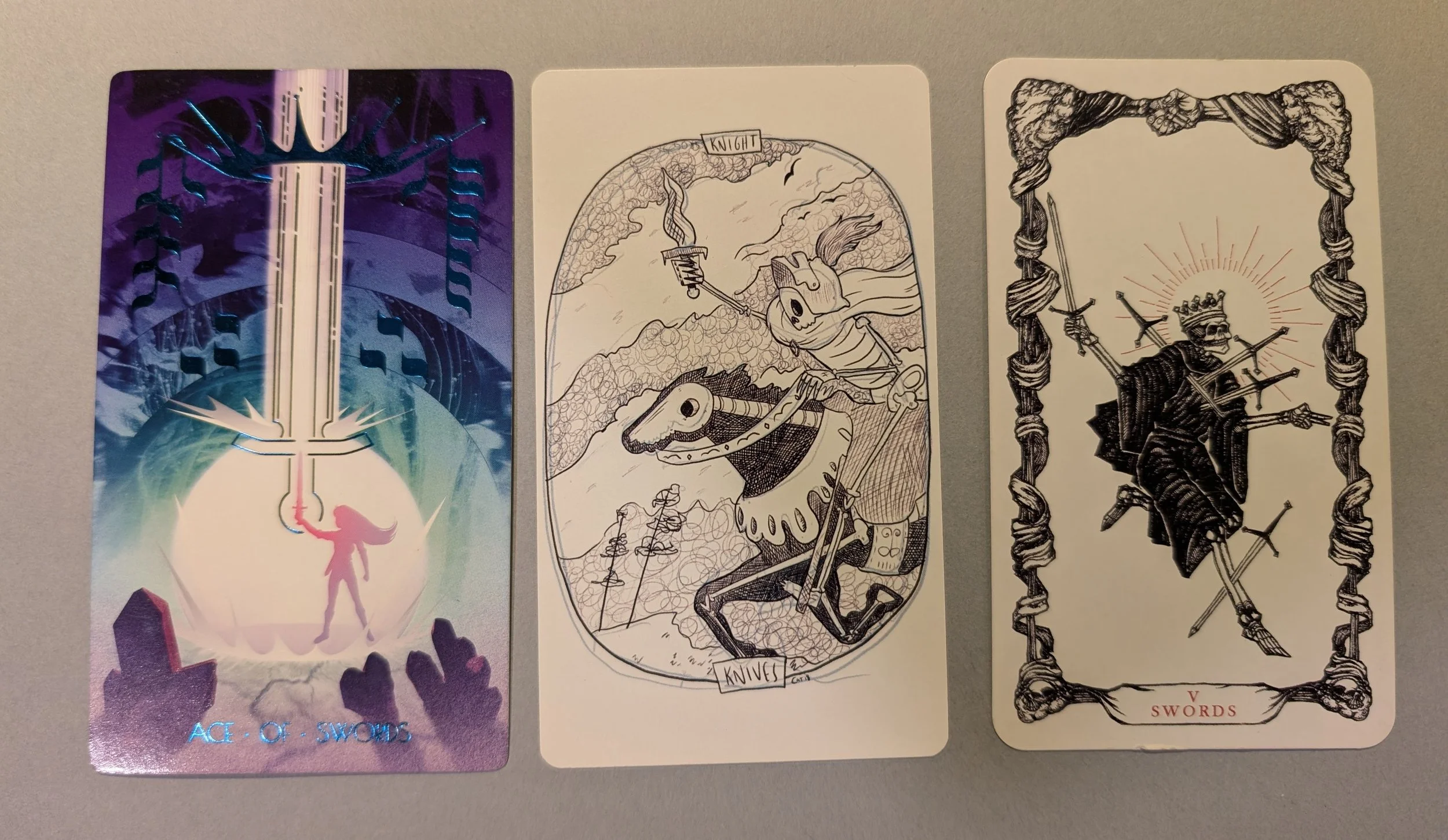
From my magpie deck, this had a 1.62% chance to appear. The Ace of Swords by Ayolland, the Kanve of Knives by Cat Rocketship, and the Five of Swords by Micah Ulrich.
What about Major Arcana?
For getting at least two Major Arcana, the process is similar, except there are 22 cards as opposed to 14. The Math is (22*21)/(2*1) = 231, for the possible Major Arcana cards you could pull, then you have to add a minor arcana you can pull as well, which is 56/1 or 56. So the total number of combinations is 231*56 or 12,936.
We also need to determine the total possible combinations of the 3 Major Arcana. The equation for that is (22*21*20)/(3*2*1) or 9,240/6 or 1,540.
If we add the combinations from the two scenarios above, we get 12,936 + 1,540 = 14,476. We divide that by the total combinations above (76,076), and you get ~19%. Less impressive.
Specific vs. General: Pulling it all together
If you consider the 8% chance for a particular suit to have two cards in a three-card spread significant and worthy of interpretation, it is going to happen more frequently than you think. Since there are 4 suits, the odds that at least two cards in a three-card spread are of the same suit are (8% x 4), or 32%.
In short, about a third of the time, a three-card spread’s suit distribution is going to have something to say. A lot of probability works this way. For something specific, like “two swords in a three-card spread,” you have a low probability, but for a general “two cards of the same suit in a three-card spread,” it’s much higher. In my experience, that is a hard connection to make. In the same vein, it takes a smaller population to find two people with the same birthday than to find someone with your birthday.
Why go through all this math?
Well, I am a giant nerd. Part of this is me learning how to calculate those odds, plus you can double-check everyone else’s calculations, which can be wrong. Also, I don’t have a standard tarot deck; my deck is a magpie/patchwork deck with 120 cards. It has 80 minor arcana (with 20 per suit) and 40 Major Arcana cards. Thus, I have to calculate the odds specific to my deck.
Calculations with a 120-card deck
For a standard three-card pull, there are (120*119*118)/(1*2*3), or 280,840 combinations.
To determine how many possible successes there are, you can follow the process above with the standard tarot deck and just substitute my deck’s numbers. For my deck, there are 20 cards in each minor arcana suit. Two successes in a three-card spread is (20*19)/(1*2) or 380/2 or 190. Then the final non-suit card is 100/1. Multiply those results to get 19,000 as the possible totals.
Then the results of pulling all three cards in the same suit: (20*19*18)/(1*2*3) or 6840/6 or 1140.
You add the total number of successes above (19,000+1,140 = 20,140) and then divide by the total number of combinations, 280,840. The result is 7.17% or about the same. See the table below for percentages.