The Allbright, Nine of Wands, and the Magician
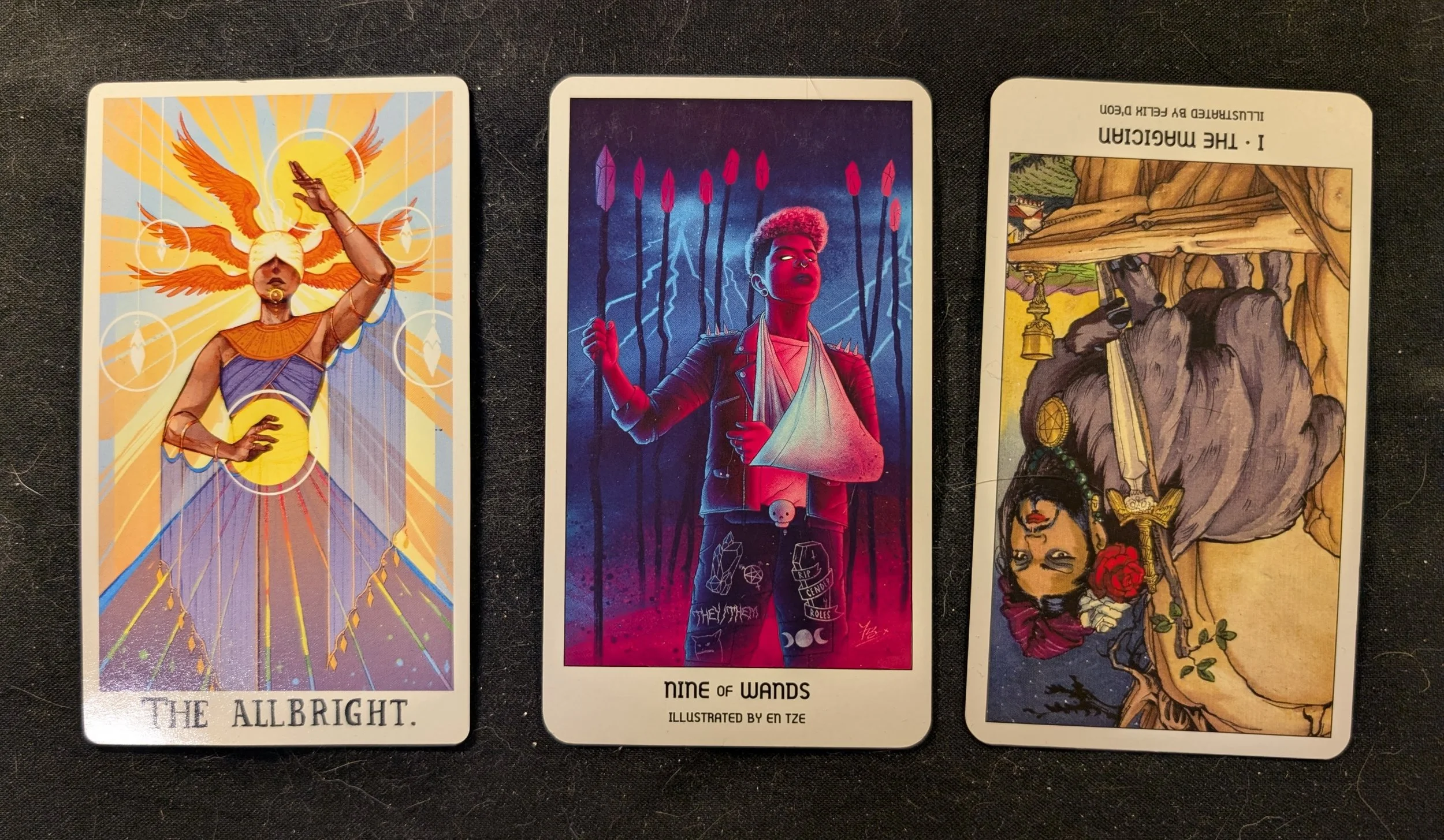
The Allbright by Annalise, from the Alleyman’s Booster Pack#2. Hope incarnate.
Nine of Wands by En tze. Bloody but unbowed. The Nine of Wands shows a person in a defensive posture. They have been through violence before, as shown by their broken arm, but they remain ever vigilant against what is out there. They stare at the reversed Magician.
The Magician by Felix D’eon. You could talk all day about this card. The first in the major arcana. Used to symbolize beginnings, values, and potentially the use of magic. However, the card is reversed. This leads me down the rabbit hole of the trickster interpretation. In older versions of tarrocchi games, the magician was known as a “stage magician”. This card was the lowest trump card available. It symbolizes power—it is a trump card after all—but that power has a thin veneer.
This is such a wondrous pull: Your hopes from the Allbright are protected by the Nine of Wands. Out there, you see a falsity you need to guard against. Before you start delving deep, ask yourself a few questions: “What brings you hope?” and “What makes you feel safe?” These are no mere easy questions, and they can be hard to answer. Then, after a moment, take a look at the magician. What stage magic are you trying to protect yourself from? Is that protection worth the effort?
An apt example for me is tarot itself. I am particularly wired to have an analytical mind. I do not believe that tarot cards can read the future, nor can they answer specific questions. “Why can’t I get a better job?” is just outside the bounds of what the cards can answer. We are pattern-seeking individuals, and through various logical fallacies, come to believe that these cards have actual power. I believe in science (as messy and terrible as it is) and that observation and experimentation have an important role in determining how we interact with the world as we experience it. Divination is not a part of that.
However.
I do believe that Tarot can act as a way to ask questions of yourself. To approach your behavior and life choices mindfully. In psychology, it often takes a critical moment to knock someone out of their normal operating patterns. A car crash. An honest talk with several friends. A breakup. The birth of a child. Turning 40. Retirement. Getting married. I think for some people, asking these questions with tarot opens a door to experience moments of change without a “critical event”. When you pull cards, you take time, zoom out, and ask questions about your life and the choices that follow.
The cards don’t mean anything particular. You can get different interpretations, and no one fully agrees, per se. However, deciding to do a spread and to be open to what the random pieces of plastic-coated paper tell you gives you the chance for deep interrogation. To change, if that is what you need. To be different from what you once were, if that is where you want to go.
Thus, the defensiveness in my life toward dismissing tarot—as I did in my younger days—as “pseudoscience and bullshit,” was there to protect my hopes pinned on science and cold, hard analytic truth. Now, as I am a bit wiser, I can see that there can be a synthesis between the use of tarot and an earnest belief in the scientific process.
Maybe instead of being defensive about an attitude or belief, the cards are asking you to take a moment and ask, “Why?”